


The exponential growth of cloud computing, Artificial Intelligence (AI), edge applications and 5G connectivity is creating unprecedented demand for digital infrastructure. Data centres have become the backbone of the modern economy, yet the challenge facing developers, operators and hyperscalers is clear: how can capacity be delivered faster, more predictably and at scale?
Increasingly, the answer lies in industrialised construction.
By combining standardisation, prefabrication and repeatable manufacturing processes, industrialised construction is reshaping how critical infrastructure is designed & delivered. What was once viewed as an alternative construction methodology is rapidly becoming a strategic enabler for data centre development.
Meeting Demand in an Era of Accelerated Growth
The pace of demand growth has fundamentally changed the requirements of data centre delivery. Operators are under pressure to bring new capacity online quickly, while navigating labour shortages, supply chain constraints and increasing sustainability expectations.
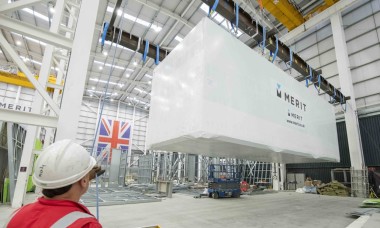
Traditional construction methods often struggle to keep pace with compressed delivery schedules. Industrialised construction addresses this challenge by shifting significant portions of the build process from site to factory environments, where critical systems can be manufactured, assembled and tested in parallel with site preparation works.
This approach can accelerate overall project programmes by up to 60%, helping developers achieve faster time-to-market while reducing programme risk.
Tackling Labour Challenges Through Manufacturing
Labour availability remains one of the most significant challenges facing the construction sector globally. Data centres require highly skilled trades to install increasingly complex power, cooling and MEP infrastructure, often in markets where competition for talent is intense.
Offsite manufacturing helps mitigate these pressures by relocating specialist activities into controlled production environments. Rather than relying solely on large site-based workforces, critical systems can be manufactured by dedicated teams using repeatable processes and standardised quality controls.
The result is a more resilient delivery model that reduces dependency on local labour availability while improving productivity and consistency.
Raising the Bar on Quality and Programme Certainty
For mission-critical facilities, quality is non-negotiable.
Data centres rely on precise integration between power distribution, cooling systems, controls and structural elements. Even minor installation inconsistencies can create operational risks and commissioning challenges.
Industrialised construction reduces variability by manufacturing components in controlled factory conditions, where quality assurance procedures can be embedded throughout production. Factory testing and pre-commissioning activities further reduce installation risk once systems arrive on site.
This standardised approach also improves programme certainty. With manufacturing and site activities progressing simultaneously, project teams gain greater control over schedules and fewer opportunities for delays caused by weather, site congestion or labour availability.
The Rise of Modular Data Centres
One of the most visible examples of industrialised construction is the emergence of modular data centres.
Using pre-engineered, factory-built modules, these facilities can be deployed in a matter of weeks rather than months.
This model is proving particularly attractive for edge computing, AI workloads and locations where rapid deployment is essential. Organisations requiring localised computing capacity can deploy infrastructure closer to end users, improving performance while retaining greater control over their data and operations.
The approach is also gaining traction among government, defence and security-sensitive organisations, where data sovereignty and operational control are increasingly important considerations.
Looking Beyond Traditional Construction Models
Research across the sector suggests prefabricated and modular solutions now account for between 40% and 60% of a typical data centre's components, with some leading designs incorporating significantly higher levels of industrialisation.
However, the industry may only be at the beginning of this transition.
Other sectors, including oil and gas, energy and advanced manufacturing, have long embraced large-scale modularisation strategies involving highly integrated equipment packages assembled offsite. Similar approaches are increasingly being explored for complete MEP packages and other major data centre systems.
As demand continues to accelerate, the organisations best positioned for success will be those willing to adopt new delivery models, leverage manufacturing-led thinking and embrace greater standardisation across the value chain.
Industrialised construction is no longer simply a construction methodology. It is becoming a critical strategy for delivering the next generation of digital infrastructure - faster, safer and with greater certainty than ever before.