


“Productivity isn’t everything, but in the long run, it’s almost everything.” This observation by Nobel Prize-winning economist Paul Krugman remains as relevant to construction today as it does to any sector driving economic growth. Yet, despite decades of technological advancement, the construction industry continues to lag behind. Output per worker in the UK remains around 13% below the G7 average, reflecting a persistent and systemic productivity gap.
At the heart of this challenge lies an reliance on fragmented delivery models and procurement practices that reinforce the status quo. Traditional construction has proven remarkably resilient - not because it is optimal, but because it is dominant. Multi-tiered supply chains, disjointed accountability and lowest-cost procurement models have created an ecosystem that resists meaningful change.
The consequences are clear. Projects are routinely delayed, costs escalate and the delivery of critical infrastructure - particularly in sectors such as healthcare and life sciences - is too slow to meet urgent societal needs. As demand grows for highly technical environments, the limitations of traditional approaches become even more pronounced.
“There is a fundamental issue with how construction is structured,” says Tony Wells, CEO at Merit Industrialised Construction. “The traditional Tier 1, 2, 3 model is outdated. It simply isn’t agile enough to deliver the level of innovation and certainty the UK now requires.”
Compounding this is the challenge of ageing estates. Much of the UK’s infrastructure is no longer fit for purpose, yet replacing or upgrading it through conventional means is too slow and inefficient. In parallel, procurement frameworks often unintentionally block innovation, requiring contractors to demonstrate delivery of similar projects within narrow timeframes. While designed to reduce risk, these criteria frequently exclude new technologies and approaches that could significantly improve outcomes.
“The system is geared to reward what has been done before, not what could be done better,” Tony adds. “If we are serious about productivity, procurement must evolve to support innovation - not suppress it.”
This is where offsite and industrialised construction offer a compelling alternative.
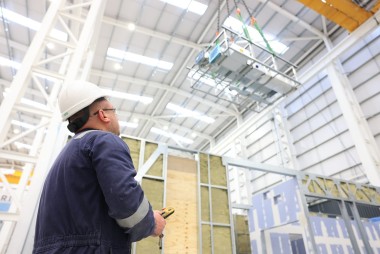
By shifting activity from unpredictable construction sites to controlled manufacturing environments, offsite construction introduces a fundamentally different delivery model. Digital design, advanced manufacturing and parallel working enable a step change in construction efficiency.
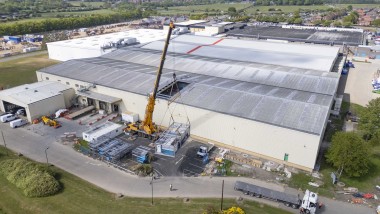
Merit’s approach exemplifies this shift. Through vertically integrated delivery, spanning BIM modelling, design for manufacture (DfMA), pre-assembled module (PAM) production and on-site assembly, the company has developed a platform-based solution that redefines productivity benchmarks.
The benefits are tangible. Facilities can be delivered up to three years faster than traditional methods, at a fixed price and with a level of certainty that is rarely achieved in conventional construction. For sectors such as biotech and pharmaceuticals, where speed to market and validation are critical, this is transformative.
Offsite construction also aligns with broader economic and environmental priorities. By fostering high-value manufacturing within the UK, it supports domestic industry and drives investment in skills and innovation. At the same time, controlled production environments improve quality, reduce waste and enhance safety.
“Industrialised construction isn’t just about building faster,” Tony explains. “It’s about building smarter, delivering consistent quality, reducing operational costs and eliminating inefficiencies at every stage.”
However, realising this potential requires more than technological capability. It demands a shift in mindset across the industry. Incremental change will not be enough. As Clayton Christensen’s theory of disruption suggests, meaningful transformation comes from fundamentally different approaches, not from adapting existing models at the margins.
There are signs of progress. Government interest in offsite construction is growing, and sectors with urgent delivery needs are increasingly open to new methods. But without structural changes to procurement and a willingness to prioritise long-term value over short-term cost, the pace of change will remain limited.
“The opportunity is there,” Tony concludes. “But it requires commitment from clients, from policymakers and from the industry itself, to do things differently. Without that, we risk repeating the same patterns and missing the chance to fundamentally improve how we build.”
Construction productivity has been stagnant for too long. Offsite construction provides a credible, proven pathway to change. The question is no longer whether the industry can evolve - but whether it is willing to.